
Solar Street Lights for Estates, Schools and Farms in Kenya

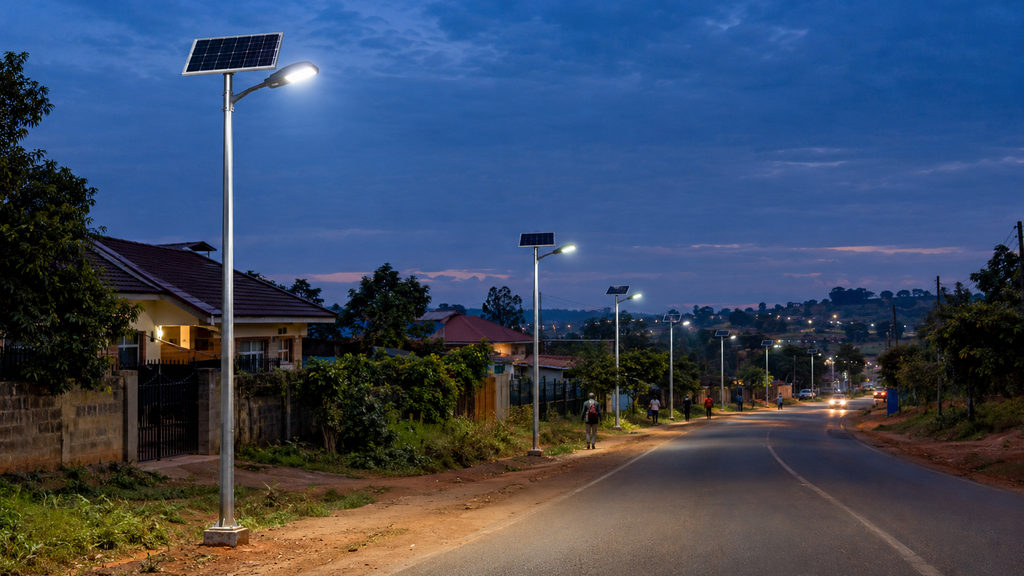
A single solar light is a product.
Twenty solar street lights around an estate are a lighting project.
That difference matters.
If you are planning lighting for a school, farm, residential estate, hotel, church or commercial property, simply choosing a high-wattage fixture and multiplying it by the number of poles is unlikely to give you the best result.
The real question is how the entire property should be illuminated.
Start with the site
Walk through the property during the day and identify the places that will need lighting at night.
For an estate, that could mean internal roads, entrances, parking and pedestrian areas.
For a school, it might be the main gate, walkways, dormitory approaches, administration areas and access roads.
For a farm, you may be more concerned with entrances, farm buildings, access roads and areas around equipment or worker facilities.
Every site has a different lighting story.
Don’t begin with wattage
Wattage is useful, but it shouldn’t be the first question.
Start with the road width, mounting height, required illumination and spacing between poles.
A light installed very high may spread illumination over a broad area, while a lower installation may concentrate it more strongly.
The beam pattern also matters.
This is why professional lighting design considers the whole installation rather than treating each light as an isolated product.
How many solar street lights do you need?
There is no universal formula such as “one light every 20 metres.”
The correct spacing depends on the actual light distribution, mounting height, road width and required lighting level.
Two roads that look similar on a map may need different lighting arrangements if the surroundings, trees or buildings are different.
For a serious project, provide the supplier with a site plan or photographs.
That gives them something real to work with.
The battery becomes important on a large project
When you have one solar light, battery capacity is important.
When you have fifty, it becomes a project-design issue.
The battery needs to store enough energy for the intended operating schedule.
Its capacity should be considered together with the panel and the actual energy consumption of the light.
A battery rated in Ah should also be considered alongside voltage because:
Wh = Ah × V
This gives a more meaningful indication of stored energy.
The solar panel is the energy source
During the day, the panel collects energy.
At night, the battery supplies that energy to the light.
If the panel is shaded by trees or buildings, charging can be affected.
This becomes particularly important on estates and farms where vegetation can change over time.
A good installation should therefore consider not only today’s sunlight but also future obstructions.
What happens during cloudy weather?
Solar street lights depend on stored energy.
If several days of poor solar conditions reduce charging, the amount of energy available at night can be affected.
That doesn’t mean solar street lighting is unsuitable for rainy regions.
It means the system needs to be appropriately designed for its environment.
Battery capacity, panel sizing, lighting schedule and actual consumption all matter.
All-in-one or separated components?
Solar street lights come in different configurations.
Some integrate the main components into one fixture, while others separate the solar panel and lighting unit.
Neither approach is automatically superior.
The right design depends on the project, maintenance requirements, panel positioning, security and installation environment.
What should a school or estate manager ask the supplier?
Don’t settle for a quotation that only says:
“20 solar street lights.”
Ask what those 20 lights actually consist of.
Find out the model, battery, panel, light output, protection rating, recommended mounting arrangement, warranty and installation requirements.
You should also understand whether the quoted price includes poles, brackets, installation and transport.
A site plan can make the conversation much easier
If you are planning a substantial installation, send:
- A site plan if available
- Photos of the property
- Road dimensions
- Number of areas requiring lighting
- Approximate pole positions
- Any existing lighting
- Areas with heavy tree cover
This allows the supplier to think about the property as a system.
SolarCity and larger lighting projects
SolarCity operates across residential and commercial solar applications and currently lists solar street lighting among its broader renewable-energy offerings.
For a project, the most useful first step is not necessarily choosing a product from a catalogue.
It is explaining what you need illuminated.
From there, the appropriate product and quantity can be discussed.
Frequently Asked Questions
Are solar street lights suitable for estates?
Yes, they can be considered for estate roads, entrances, parking and pedestrian areas, depending on the project’s requirements.
How far apart should solar street lights be?
There is no universal spacing. It depends on the light’s distribution, mounting height, road width and desired illumination.
Are solar street lights suitable for farms?
They can be useful around farm entrances, access roads, buildings and other outdoor areas.
Do solar street lights work during power cuts?
Standalone solar street lights are designed to operate from stored solar energy rather than depending directly on grid electricity.
How many solar street lights does a school need?
That depends on the school’s layout and which areas need illumination.
Planning a solar street-lighting project? Send SolarCity your site photos or layout and let the discussion start with the property—not just the wattage.